Occupied West Bank ‘military zones’ become de facto Israeli settler land
Closed military zones in the occupied West Bank are being seized by settlers and made into staging posts for pogroms against Palestinians.

 By Al Jazeera Staff23 Nov 2026
Ramallah, Occupied West Bank – Saleh Zahran had a room on his family’s land with a television, a fireplace, a fridge and solar panels. The kids would play in the groves, and the men stayed up late at night watching the stars.
“We’d cook, eat, drink, spend a whole day from morning to sunset,” he says.
end of list
Zahran, 39, inherited the farmland, with 120 olive trees, in Deir Abu Mishal, a village west of Ramallah, from his grandfather and father, splitting it among his brothers.
Between 70 and 80 percent of people in the village, which falls in Area B, under joint Israeli-Palestinian control, live off the land, and just a few years ago, there were no settlers nearby.
“We’d come and go whenever we wanted, pick our fruit at our own pace, sell, build, and marry off sons from the olives. Now, it’s all gone,” he told Al Jazeera.
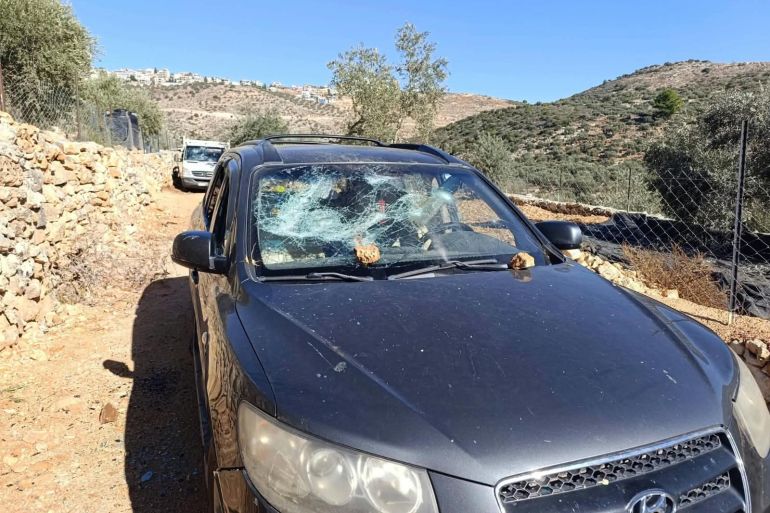
Since settlers set up an outpost in Area B about 1km from his land in June, nobody in his family had been able to reach it. Settlers attacked their cars, and his elderly father was pepper-sprayed while trying to reach the farmland, he says.
On November 10, an Israeli High Court decision granted the village two days of army “coordinated” harvesting, something once unthinkable in Area B.
Zahran set out with his brothers to reach their lands for the first time in five months, but about 20 settlers came at them. They threw stones, smashed the family’s truck and his brother’s four-wheeler and slashed the tyres. He saw no soldiers, and police never arrived despite their calls.
The next day, the army and its liaison office were present. But farmers were held up until about 9am, shown a map of permitted areas, and told to leave by 2:30pm. Ghiyath Nasser, their lawyer, says villagers could reach less than a third of the area in question, so Zahran could harvest only about 20 of his 120 trees.

After five months, Zahran finally reached the farm room that day only to find settlers had stolen or smashed his belongings and were drawing water for their sheep from the two wells he had restored. The saplings he had planted last year had died of thirst.
On paper, it is the settlers who are barred from the Zahran family’s property and the land around Deir Abu Mishal. But in practice, it is Palestinian owners like Zahran who are kept out.
Nasser says that after his first legal petition, the army twice demolished the outpost – which was immediately rebuilt both times – then declared the site a closed military zone for Israelis only. That, Nasser argues, means soldiers cannot demand permits or “coordination” from Palestinian owners – their job is to keep settlers out.
“Sometimes they declare an area closed to settlers, but in the application they close it to Palestinians,” said Wail Qut, a lawyer with the Jerusalem Legal Aid and Human Rights Center (JLAC), who is from Madama, south of Nablus.
Kerem Navot and Peace Now’s July report found that, at the end of 2025, farm outposts effectively controlled more than 1 million dunams (247,105.4 acres), about 18 percent of the West Bank — roughly 750,000 dunams (185,329 acres) taken since late 2022.
‘A de facto closure’
In Madama, closures came first, and the outposts followed. Qut says its northern land was never declared a closed military zone, but the effect was the same.
About five years ago, the army gated the road from the village to Nablus, citing security concerns, he says. It was the only access to as much as a third of Madama’s land. The Israeli High Court dismissed the villagers’ petition after the army said farmers could reach the land on foot or by animal and apply for permits.
“It’s a de facto closure, though,” said Qut, with farmers still barred from entering.

Then, last April, an outpost of what Qut estimates are now 10 caravans appeared inside the closed area. He said the army suddenly reopened the gate for the settlers to use. Qut and his brother were stopped by a settler in the same area when they tried to pick olives there this year, forcing them to leave under armed threat.
Dror Etkes, founder of Kerem Navot, which tracks settler land takeovers, says such closures without orders are common across the occupied West Bank. “There is no vacuum in the West Bank,” he said. “Once an area is closed to Palestinian access, settlers sooner or later will come and take it over, and this is exactly what happened in Madama.”
But Qut finds the courts complicit too. When JLAC petitioned over the outpost north of Madama in September, the court gave the state until May 2027 to respond, rather than a few days, as Qut expected.
‘On the pretext of I don’t know what’
On November 13, a wedding was due to take place in al-Mughayyir, located at the northeastern edge of the Ramallah governorate. “Despite the pain and the suffering, people rejoice,” said Samir Abu Alia, 60, a village council member whose cousin’s son, Hassan Abu Alia, 30, was the groom. But soldiers violently cut the festivities short.
“The moment the patrols came down, they surrounded the hall, 20 army jeeps, and started throwing stun grenades between the men and the women,” recalled Abu Alia. Soldiers took the groom and relatives away from his bride for two hours. Abu Alia and others say the groom was beaten.
It began earlier that day on the eastern plain, when a settler grazing his flock inside a closed military zone claimed someone from al-Mughayyir had thrown firecrackers or shot at him, although he was unhurt. Soldiers accepted the settler’s claim at face value and then sealed and raided the village. The army quickly targeted the wedding, claiming there were gunshots and firecrackers, which attendees deny.
About 80 percent of al-Mughayyir’s 43,000 dunams (10,625.5 acres) lies beyond its eastern entrance, closed for years. Abu Alia says villagers can now move freely in only about 900 dunams (222.4 acres). “The rest of the land they’ve taken over, they stop people from reaching it, on the pretext of a military zone, on the pretext of security, on the pretext of I don’t know what.”
Here, the outpost came first. Village council member Marzouq Abu Naim says the first outpost on the eastern plain appeared in 2018 and has grown from 200 dunams to 5,000 dunams. He counts a dozen around the village. “One of the settlers comes, brings a tent, pitches it on a hilltop … the second day, the third day, you find there’s facilitation, something not normal: [authorities] run him water, they run him electricity, they lay a road to this tent,” he said.
According to Abu Naim, when villagers tried to use the eastern entrance about two months ago, settlers attacked and tried to burn cars and tractors, and the army did nothing to intervene.

Abu Naim, whose son, Jihad, 32, was shot dead by a settler during an invasion of the village school in April, also lost a 10-dunam grove of about 250 olive trees. “It wasn’t me who planted them, or my father — our grandfathers planted them.”
In August 2025, after a shooting wounded an Israeli teenager, the army ordered olive trees beside a settler road through the plain cleared as a “security threat”, and settlers joined in. Locals say more than 10,000 trees were eventually uprooted, including 230 belonging to Abu Alia.
Documents from the Israeli NGO Yesh Din show the area was closed for 30 days to “preserve the aims of the clearing”. Renewed in October 2025, the order extended to July 2026 with redrawn boundaries, and again through December.
The order bars everyone without a permit, settlers included. But Yesh Din’s legal objection says it is enforced only against the owners, while settlers graze, plough and build on their plots. When the army’s legal adviser declined to enforce the closure against settlers, he referred Yesh Din to the Israeli Defence Ministry’s legal adviser instead, which the NGO says was an effort to absolve the army of responsibility.
Lior Zur, a Yesh Din lawyer representing the petitioners, told Al Jazeera, “Through this policy of selective enforcement, the military turns closure orders into a mechanism for transferring possession of land from its lawful Palestinian owners to settler trespassers.”
The ‘height of injustice’
The pattern runs across the West Bank. In March, a closed zone around Duma was enforced against Israeli solidarity activists protecting Bedouin families, rather than settlers; after soldiers removed the activists, settlers invaded the encampment, forcibly displacing the community the next day.
In Burin, farmland sits in closed zones renewed every month or two; settlers have gutted five greenhouses in these closed zones already. In Taybeh, an August order barred Israelis and foreigners, but settlers and outposts remained, including one near the edge of Area B that led to another unevenly enforced closed zone.
Similar cases have occurred in Ein al-Duyuk, Qusra, Umm al-Khair and elsewhere. In closed and firing zones the Israeli army has not used for decades, Etkes said, settlers are “filling in”, even though the orders formally apply to settlers, too.
The result, this olive harvest season, has been unprecedented levels of violence and access restrictions. The United Nations Humanitarian Country Team for the occupied Palestinian territory said on November 20 that more than 400 settler attacks that caused casualties or damage had been recorded since September, more than in any previous season. The infrequent “coordination” access windows, it said, are often followed by “cancellations, denial of entry, expulsion or attacks”.
“What started as local initiative has been adopted by the military and is today, maybe not a declared policy, but an implemented policy,” said Etkes. The outposts are “not legal, but they are completely supported by the military, by the government, without officialising it”. The Israeli Civil Administration has leased large areas of the West Bank to settlers for grazing, which they never do for Palestinians, Qut said.
“Military closed-zone orders and settler takeovers of Palestinian land are two complementary practices,” said Yair Dvir, spokesperson for Israeli NGO B’Tselem. “The military uses these orders to drive Palestinians off their land, while settlers are frequently allowed to remain or establish outposts.”
Back in Deir Abu Mishal, olives are rotting on trees as the season ends. Zahran’s three young children ask why they cannot return to the farm room for barbecues and the olive harvest. He tells them it is too dangerous. “Four or five settlers stop a whole village, 5,000-6,000 people, from going to the land,” Zahran said. “We are living the height of injustice.”