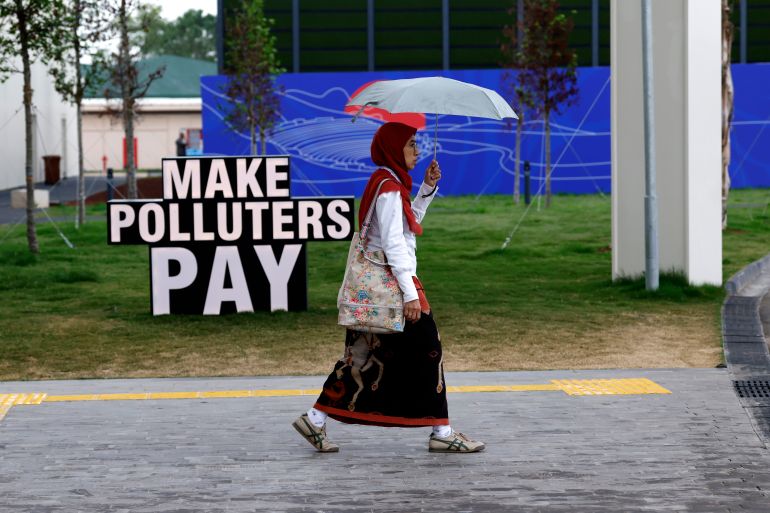
COP31: What next after UN climate talks collapse
UN member states fail to agree on how to fast-track action to reverse global warming in blow to climate agenda.

23 Nov 2026
UN climate talks have ended in collapse after countries deadlocked over the phasing out of planet-warming fossil fuels, aiding energy transition for developing countries and the response to natural disasters.
The talks in Antalya in Turkiye, known as COP31, ended on Sunday as the European Union and others rejected a final deal they said was too weak to advance the fight against global warming.
end of list
The longest UN climate summit on record brought to the fore the divide between major polluters driving climate change and smaller nations bearing the brunt of its impact, after a year of climate-linked disasters from Europe to Asia.
It also laid bare the world’s inability to keep the Paris Agreement pledge to limit global warming to the 1.5C (2.7F) mark, which scientists expect to overshoot in a few years.
So what’s next for the fraught UN process and what else can nations do to deliver promises that have too often missed their target?
Why did COP31 collapse?
The 11-day-long negotiations that began on November 9 were stalled after oil-producing states blocked any mention of phasing out fossil fuels in the final deal put forward by the president of COP31, Turkiye, and main negotiator Australia.
Saudi Arabia and fellow members of the Organization of the Petroleum Exporting Countries (OPEC) opposed any mention of a fossil fuel phase-out, while insisting instead on carbon capture, the technology criticised as costly and ineffective.
Cosima Cassel, Programme Lead in Climate Diplomacy and Geopolitics at environmental think tank E3G, said petrostates attempted to slow momentum on the energy transition “following the disruption of the Strait of Hormuz and the projected decline in their incomes as global demand for fossil fuels falls”.
The European Union and several nations particularly vulnerable to climate change said they could not accept a text that failed to mention the main driver of global warming.
The revised text of a deal that emerged early on Sunday was angrily rejected after around 130 nations sent a letter to the presidency stating that a deal would have to mention a path for transitioning away from fossil fuels.
On the contrary, the text made no mention of fossil fuels while promoting carbon capture.
“A small group of blockers set the outcome against the clear position of a large majority,” Cassel told Al Jazeera. “These dynamics raise questions about the role of oil and gas exporters in undermining the only forum where vulnerable countries get to advance their concerns.”
Crucially for developing countries, there was also no progress on the funds needed to help them transition their energy systems and respond to natural disasters.
Under the 2015 Paris Agreement, developed countries are required to provide financial support to developing nations. However, the US-Israeli war on Iran and Russia’s war on Ukraine strained national budgets, leaving wealthy nations unwilling to commit trillions of dollars in climate finance.
Sebastien Duyck, Senior Attorney at the Center for International Environmental Law (CIEL), said wealthy developed countries, which denounced the obstruction by fossil fuel-producing nations, showed “considerable hypocrisy”.
“You cannot demand a just transition from others while failing to pay your fair share of its costs,” Duyck told Al Jazeera. “We need less finger-pointing and political theatre and more accountability. All major economies, particularly the wealthiest, must deliver on their existing legal obligations and climate finance commitments ahead of COP32.”
What’s next for the UN process – and for the planet?
The collapse of climate talks in Turkiye has renewed questions about reform of its consensus-based process, centred around the principle that all countries must agree to the reforms.
The commitment to moving away from fossil fuels – including natural gas, coal and crude oil – was considered a landmark achievement of COP28 in Dubai. But even then, the deal stopped short of calling for a “phase-out”, amid fierce lobbying from oil-producing countries.
Amid concern that fossil fuel producers wield more power than those who want to accelerate the transition to a low-carbon world, many believe the COP process remains important as a platform that brings together virtually every country in the world.
“The UN process remains the only forum where every country has a voice and a chance to shape outcomes and it is worth protecting and fighting for,” said E3G’s Cassel.
However, calls for reform are multiplying and a second tier of COPs – the Global Climate Action Agenda – is rising in prominence. Often called just the Action Agenda, the voluntary implementation pillar of the UN Climate Change process (UNFCCC) is bringing in real-world actors such as financial institutions, cities, regions, businesses and civil society on a voluntary basis.
“That spirit of collaboration stands in stark contrast to the adversarial dynamics that too often dominate the formal negotiations,” Cassel said.
Other routes are also being pursued. An International Court of Justice (ICJ) advisory opinion last year confirmed that states have a binding legal obligation to combat climate change. In April, the Santa Marta initiative convened 57 countries to promote non-binding cooperation around fossil fuel phase-out.
Duyck, at CIEL, said “the failure of governments to agree at this conference does not make the science any less clear or their legal obligations any less binding.” “A fair and orderly transition away from fossil fuels remains both an imperative and a collective responsibility,” he added.
The UN Environment Programme (UNEP) last year said the world would exceed the 1.5C (2.7F) mark – the internationally agreed-upon target set under the Paris Agreement – “very likely” within the next decade.
Without any meaningful action, the planet will warm 2.3 to 2.5C (4.1 to 4.5F) by 2100, the report said.
Joeri Rogelj, Professor of Climate Science and Policy at Imperial College London, said a starting point would have been to renew commitments made at COP28 in Dubai, where nations had agreed to transition away from fossil fuels in energy systems, triple renewable energy capacity globally and double the global average annual rate of energy efficiency improvements by 2030.
Instead, “even simply echoing these agreed outcomes was politically too challenging for some countries with strong vested interests in fossil fuels,” he told Al Jazeera.
“The commitments needed are clear: global greenhouse gas emissions must decline to slow the rate of global warming,” Rogelj told Al Jazeera.
“This failure risks further delaying meaningful global emissions reductions, with the poorest and most vulnerable countries and communities bearing the greatest consequences.”