How far will Egypt go to help Saudi Arabia secure the Red Sea?
Regional analysts highlight the growing security alignment between Cairo and Riyadh amid escalating Red Sea tensions.


17 Sep 2026
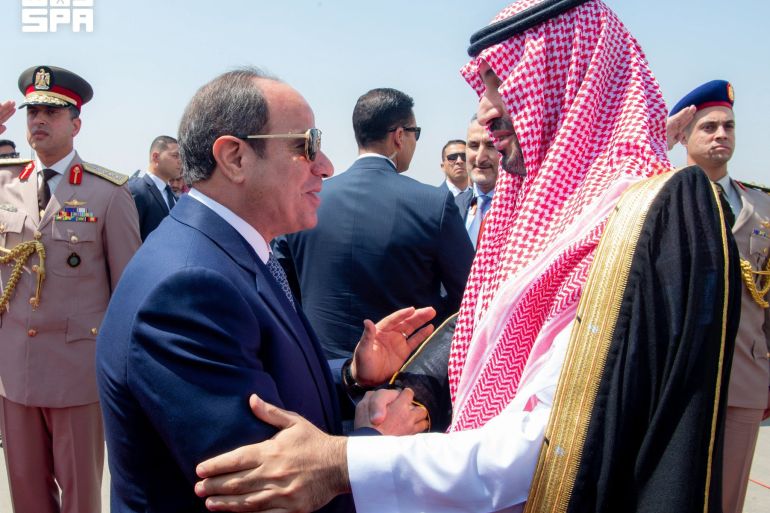
Saudi Crown Prince Mohammed bin Salman’s latest meeting with Egyptian President Abdel Fattah el-Sisi this week came at a highly sensitive moment for both countries.
Mere days before Tuesday’s meeting, Iran-aligned Houthi rebels seized Yemen’s Red Sea coast, gaining significant control over the Bab al-Mandeb strait, the southern gateway to the Suez Canal.
end of list
This precipitated a Saudi air campaign over Yemen and repeated attacks by the Houthis on the kingdom’s oil infrastructure.
Analysts say Riyadh is looking for help to protect the kingdom and Red Sea shipping, and that Egypt, whose Suez Canal revenue depends on the same traffic, is an obvious partner.
The deepening bilateral relationship carries significant implications for the region, from the conflicts in Yemen and Sudan to Egypt’s close ties with the United Arab Emirates and Saudi Arabia’s new defence pact with Turkiye and Pakistan.

Purpose of the visit
Abdel Monem Said, a member of Egypt’s Senate who is close to decision-making circles in Cairo, told Al Jazeera the visit had political, economic, strategic and military dimensions.
He said it came as Iran escalated regional conflicts through what he called its proxies, chief among them the Houthis. Their advance directly threatened Egypt’s economy and the Suez Canal, he said.
Said stressed the need for joint strategic and military thinking between Egypt and Saudi Arabia that would act as a strong deterrent against Iran-backed groups from Iraq to Yemen.
He added that Egypt is eager to prevent Iran and its allies from imposing control over the region, especially over maritime traffic in the Red Sea, given the direct repercussions this has for the Suez Canal.
Andreas Krieg, a senior lecturer at King’s College London, said Cairo increasingly sees one continuous security space stretching from the Suez Canal to Bab al-Mandeb.
If that southern gateway becomes unreliable, he said, Egypt stands to lose shipping, hard currency and strategic leverage.
“I do think Cairo now has a very strong interest in substantive cooperation with Saudi Arabia on Red Sea security,” he told Al Jazeera over email.

‘A new Arab order’
In the lead-up to the meeting, the chairman of the Arab Affairs Committee in Egypt’s House of Representatives, Mohamed Salah Abu Hemila, told Al Jazeera that the Saudi crown prince’s visit may produce a new roadmap for political and strategic cooperation on a number of Arab and regional issues.
The alliance between the two nations would serve as the cornerstone for building a new Arab order — more robust, cohesive, and capable of safeguarding its interests and defending its just causes, he said.
The foremost issues would be Red Sea security and freedom of international navigation, but they would also include the Palestinian cause and the situations in Yemen, Libya and Sudan.
A statement released by el-Sisi’s office after the meeting also affirmed that “relations between Egypt and Saudi Arabia can only be exemplary within the Arab framework,” and linked Egyptian and Gulf security.
Tarek Fahmy, professor of international relations at Cairo University, told Al Jazeera that Saudi Arabia is increasingly acting within an Arab framework after the United States’s reaction to the Houthi escalations fell short of what the kingdom expected. Reports suggest that Saudi Arabia asked the Trump administration for military help in combatting the Iran-backed group, but that Trump refused. Neither Saudi Arabia nor the US has officially commented on these reports.
Red Sea security
No details of specific military cooperation between the two countries were announced during or after the meeting.
However, Egypt is already a party to a Saudi-led coalition for Red Sea maritime security launched in August. The grouping was created as a consequence of international fears that the Houthis could close Bab al-Mandeb while Iran had the Strait of Hormuz choked off.
The coalition, whose founding document stresses it is purely defensive in nature, has not taken military action against the Houthis so far. The rebel group, too, has not taken measures to shut down shipping after its recent advances.
Krieg says Saudi-Egyptian military cooperation is likely to entail intelligence sharing, maritime surveillance, protection of commercial shipping and greater coordination around the Red Sea.
But there is a “very hard ceiling” on how far Egypt will involve itself inside Yemen, he said. “The Egyptian preference will be to defend the maritime system without becoming responsible for Yemen.”
Historical memory likely plays a role in that preference. In the 1960s, Egyptian leader Gamal Abdel Nasser sent tens of thousands of Egyptian soldiers to participate in the North Yemen Civil War, a long and costly endeavour that yielded few results and many casualties.
“Yemen taught Egypt that an apparently limited intervention can become a strategic trap very quickly,” Krieg said.
A broader convergence
It’s no surprise that the two nations should seek to deepen cooperation at this moment, say analysts. The Iran war is only the latest – and perhaps greatest – in a series of regional crises that the two states have found themselves roughly aligned on.
In January, weeks before the war began, el-Sisi met Saudi Foreign Minister Prince Faisal bin Farhan Al Saud in Cairo. Afterwards, the Egyptian presidency said the two countries held “identical” views on solutions to regional crises that focus on preserving the unity and sovereignty of states.
This was reiterated on Tuesday, when the two sides “stressed that any threat to Sudan’s unity and territorial integrity poses a danger to the collective security of Egypt, Saudi Arabia and all countries of the region”, according to Egypt’s State Information Service.
“Both are deeply uncomfortable with the fragmentation of states and the rise of militias, separatist movements and externally sponsored sub-state actors,” Krieg said. “You can see that in Sudan, Libya, Somalia and increasingly Yemen.”

However, this strategic vision for the region has run contrary to Abu Dhabi’s preferences and policies.
That pre-war meeting between el-Sisi and Prince Faisal came only days after Saudi Arabia launched strikes on a United Arab Emirates-backed separatist group in Yemen, which was widely received as a repudiation of Abu Dhabi.
The UAE is long faced accusations of sponsoring the Rapid Support Forces rebel group in Sudan, driving a devastating civil war that has negative ramifications for Egyptian security. Cairo has supported Khartoum’s efforts to combat the group and restore its sovereignty. The UAE has rejected accusations that it has provided military, logistical, financial or political support to the RSF.
At the same time, the UAE is far and away the largest investor in the Egyptian economy. In 2025, its net investments in the country were more than double that of the second-biggest investor, the United States.
“This is where the Saudi-UAE rivalry becomes difficult for Egypt. Cairo does not want to choose between Saudi Arabia and the UAE,” Krieg says.
Instead, Krieg expects Egypt to compartmentalise, siding with Riyadh on security matters while preserving its economic relationship with Abu Dhabi.
Riyadh “does not need Cairo to publicly attack Abu Dhabi”, he said, but to use its geography, intelligence and influence to make certain regional strategies harder.

Multilateral limits
Saudi Arabia’s urgent need to contain the fallout from the US-Iran war has led it to embrace an increasing number of partners and allies.
Since the war began, it has signed the Mecca Joint Defence Agreement to include Turkiye in a bilateral mutual defence treaty it had with Pakistan.
It has organised a multilateral maritime security coalition for the Red Sea, sought assurances from the United States and the European Union and signed a defence agreement with Ukraine.
These measures, however, have been more form than function, say analysts. They have not deterred Iran and its regional allies from launching direct attacks on the kingdom, nor have they empowered Yemeni allies to keep the Houthis in check.
Tuesday’s meeting seemed to tacitly acknowledge the lack of a ready military solution for Yemen. Egypt expressed support for “efforts to reach a comprehensive and sustainable political solution to the Yemen crisis”.
They may, however, indicate the kind of security architecture that will emerge once the war is over.