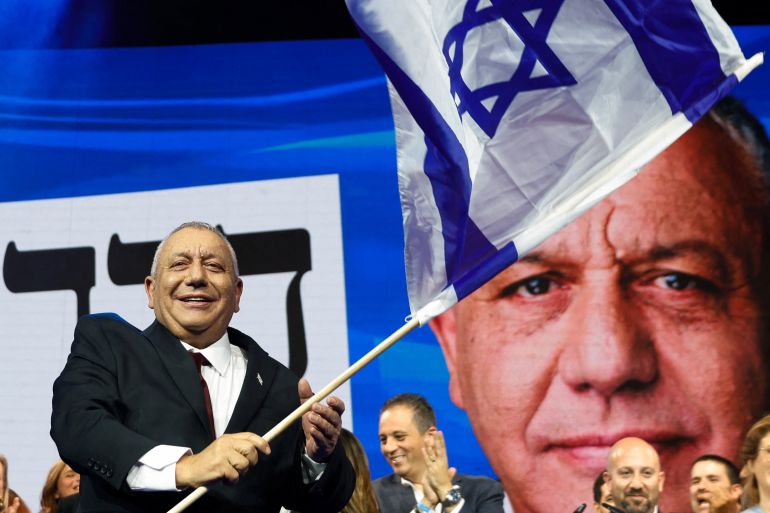
Can Israel’s opposition bloc stay united against Netanyahu?
Eisenkot’s fragile alliance must overcome deep ideological divisions to turn its opposition into a government.

 By Simon Speakman Cordall21 Nov 2026
As negotiations over the formation of Israel’s next government approach their first deadline of December 6, caretaker Prime Minister Benjamin Netanyahu appears to be seeking to exploit divisions within the opposition “change” alliance trying to oust him.
On Wednesday, he held an undeclared meeting with one of its leading figures, former Prime Minister Naftali Bennett, in a move that has prompted accusations that Netanyahu is attempting to fracture the bloc from within.
end of list
The meeting, which lasted two and a half hours, was described by Netanyahu’s office as a “security briefing”. Sources within the opposition alliance led by Gadi Eisenkot, however, characterised it as a “strategic disaster”, according to Israeli media.
Bennett had not informed Eisenkot of the meeting in advance, sources told the outlet Ynet. During a subsequent gathering of opposition leaders, Bennett is reported to have argued that they should try to pursue the possibility of a unity government with Netanyahu, Channel 12 reported.
Bennett, a right-winger, is among several prominent figures in the opposition alliance who have previously served in Netanyahu-led governments. Eisenkot himself joined Netanyahu’s emergency unity government following the Hamas-led October 7, 2023 attack on Israel, serving as a minister without portfolio and a member of the war cabinet.
Avigdor Lieberman, meanwhile – another right-wing member of the opposition bloc – served as Netanyahu’s foreign minister and defence minister.
“Netanyahu is trying to break up the [opposition] bloc for change through Bennett,” a senior figure in the Eisenkot-led alliance told Ynet in an article referencing the numerous pledges by opposition leaders, including Bennett, never to serve within a Netanyahu-led coalition again.

However, given the broad array of ideologies among the coalition leaders, stretching from the hard-right policies of Lieberman to the relatively left-wing platform of Democrats’ leader Yair Golan, and many having previously worked with Netanyahu, it remains unclear how long the bloc can maintain its unity.
Bennett himself was once among Netanyahu’s closest political allies, serving in several of his governments before breaking with him in 2021, when the opportunity arose to form an alternative administration with centrist Yair Lapid. Bennett and Lapid subsequently assembled a cross-party coalition that ended Netanyahu’s 12 consecutive years in office, with Bennett taking the premiership for the first half of its term. But he still shares many policy positions with Netanyahu.
So how cohesive is the opposition coalition, and what could be its potential breaking points?
Here’s what we know:
Is the change bloc united ideologically?
All of the bloc’s members supported Israel’s genocidal war on Gaza – at least at its start – as well as its attacks on several regional states, including Iran and Lebanon.
In terms of domestic policy, however, there are marked differences between members of the alliance.
Both the bloc’s leader, former Israeli military Chief of Staff Gadi Eisenkot, and Bennett’s electoral partner, Yair Lapid, are regarded as relatively centrist figures. By contrast, Bennett and Lieberman are firmly on the right, divided largely by their attitudes towards religion: Bennett is a religious nationalist, while Liberman is a staunchly secular politician with a background in Israel’s Russian-speaking community, increasingly at odds with Israel’s powerful religious political currents.
Standing apart is the left-wing Yair Golan, a supporter of a two-state solution with the Palestinians and an outspoken critic of settler pogroms in the occupied West Bank, which he has accused the government of encouraging or tolerating.
Is the alliance under strain?
Yes.
Beyond the prospect of Netanyahu – Israel’s longest-serving prime minister – continually attempting to undermine them, Eisenkot faces the formidable task of finding the additional 13 seats needed for a parliamentary majority. His bloc holds just 48 of the parliament’s 120 seats after the October 27 elections, leaving him dependent on bridging deep political divides among his allies if he is to form a government capable of governing.
Golan has already met political leaders from parties representing Palestinian citizens of Israel and spoken enthusiastically about forming a government with their support. However, that suggestion has been rejected by the rest of the bloc, and has provoked fierce opposition, with right-wing protesters even threatening civil war at the prospect.
Lieberman, whose Yisrael Beytenu party holds seven seats, has been particularly emphatic in rejecting any government dependent on Palestinian support. However, his longstanding and highly vocal opposition to the de facto exemption of ultra-Orthodox Jewish men from military service appears to be softening in the face of another possibility: the 13 seats held by the ultra-Orthodox parties, Shas and United Torah Judaism.
Lieberman’s willingness to compromise on conscription risks undermining one of his central electoral promises, as well as those of other opposition leaders, and could prompt a backlash from supporters.

Have the change bloc’s differences come out in the open?
In August, Bennett dismissed Eisenkot’s proposal to allow limited exemptions from military conscription that would cover the ultra-Orthodox as an “insane mistake”, warning that ultra-Orthodox politicians Aryeh Deri and Moshe Gafni would “run circles around” him. Eisenkot subsequently countered, accusing Bennett and Lieberman of engaging in “old politics” and damaging the opposition’s electoral prospects by refusing to agree that the largest party in the alliance should lead the next government.
Lieberman, just weeks before the election, branded Eisenkot “Gantz 2.0” – referring to former defence minister Benny Gantz, who joined Netanyahu’s government in 2020 despite campaigning against him – accusing Eisenkot of secretly pursuing a deal with Netanyahu and acting out of personal ambition. Golan, meanwhile, told Lieberman several days after the election that, if he was to continue to insist on a government that avoids conscripting ultra-Orthodox men, he was “welcome to form one with Netanyahu”.
What did change bloc leaders say about Netanyahu before entering the opposition?
Their previous assessments of Netanyahu have not always been so harsh.
In 2020, Bennett told reporters that, despite their personal differences, he respected Netanyahu “very much”, adding that Israel had “won a victory” by having him in office for so long and that he had “done great things” for the country.
Lieberman, meanwhile, told The Jerusalem Post in 2019 that he wished Netanyahu “only really good results” and hoped that he would be acquitted on the corruption charges that he has since cited, on numerous occasions, as evidence that the prime minister is unfit for office.