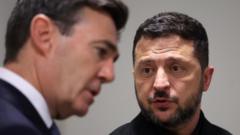
For the prime minister there was the tricky but now familiar diplomatic task of needing to show solidarity with Zelensky without appearing to criticise Trump.
Burnham’s answer was to say and announce as much as he could without exposing himself to questions from journalists asking about Trump’s latest betrayal of Kyiv.
So Downing Street issued an embargoed press notice overnight with warm words of support for Zelensky.
It said Burnham would promise to go “further and faster” in helping Ukraine with financial and military aid.
Specifically, the prime minister would pledge to speed up the delivery of lightweight multirole missiles that can help bring down fast jet-powered Russian drones.
There would be a military honour guard in Downing Street to greet Ukraine’s president, then a controlled photo opportunity showing the start of the meeting between the two men. Both would have the chance to make opening statements to the pool cameras, but without taking any questions.
Crucially, as is common with most of Zelensky’s visits to the UK, there would not be a full and open press conference where he and the prime minister would answer detailed questions at length.
In the House of Commons, at the start of his weekly question time, Burnham used the opportunity to offer what he called his “unwavering” support for Zelensky and promise greater military and financial aid in the future.
But it fell to the Liberal Democrat leader, Sir Ed Davey, to ask the question journalists might have asked if they had the chance.
Sir Ed said the prime minister had studiously avoided commenting on Trump’s decision to rip up international sanctions on Russia.
“This House does deserve to know his position, as does frankly President Zelensky and our brave Ukrainian allies,” Sir Ed said.
“Doesn’t he agree this is yet another shameful Trump betrayal of the Ukrainian people and European security?”
In reply, Burnham admitted it was a “very dark and difficult moment” for Zelensky, who was “carrying the heaviest of weights” right now.
But Burnham eschewed the chance to criticise Trump and told MPs this: “What I have to do in my role is try and repair bridges so that the support comes back and therefore I should, at this moment in time, be careful in terms of laying the ground to bring people back together. That is the role I intend to play – it’s the right role for me to play – in this moment. I will listen to President Zelensky carefully but he won’t be going away from Britain today empty handed.”
In other words, do not expect the prime minister to join in the widespread European criticism of Trump.
After the now infamous falling out between Trump and Zelensky in the Oval Office in February 2025, the UK played a key role in calming the row and bringing both sides back together.
A key player was national security adviser Jonathan Powell, who shuttled between Washington and Kyiv pouring oil on troubled waters. It seems Burnham hopes the UK can play a similar bridge-building role now.
For millions of Ukrainians facing a grim winter potentially with less US support than before, the task could not be more urgent.