Libya’s Haftar visits Turkiye days after Ukraine hits Russian warship
Ahead of Erdogan’s Libya trip, Haftar’s visit suggests Turkiye seeks another way to bring the country’s rivals together.

24 Nov 2026
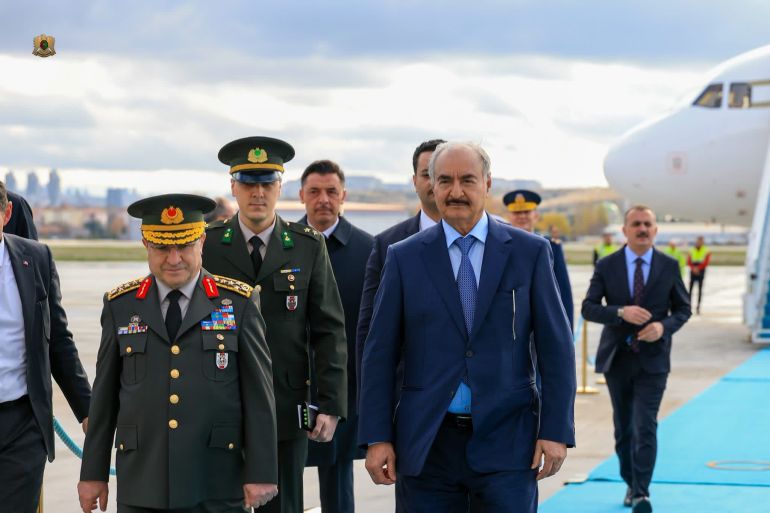
Eastern Libyan military commander Khalifa Haftar, flanked by his sons, arrived in Ankara on his first known visit to Turkiye, just days after a long-range Ukrainian attack struck a Russian ship in Benghazi.
Arriving on Tuesday to the Turkish capital, the Libyan commander was greeted by Turkish Chief of General Staff General Selcuk Bayraktaroglu at the airport, according to photos released by the General Command of the Libyan National Army (LNA).
end of list
There was no official media readout of the meeting, but Reuters news agency reported that Haftar is set to meet with Turkish President Recep Tayyip Erdogan.
Khaled and Belqasim Haftar accompanied their father to Ankara, according to the LNA’s General Command. Khaled is the LNA’s chief of staff, and Belqasim heads Libya’s Development and Reconstruction Fund.
Saddam Haftar, the LNA’s deputy commander and heir apparent, was in Doha for a separate meeting with Qatar’s minister of state for defence.
The visit came two days after Ukraine struck a Russian warship in Benghazi, the main city in Haftar-controlled eastern Libya, killing at least 10 Libyan and Russian crew members, according to local authorities.
The warship had docked to refuel and resupply under an agreement with the eastern authorities. Libya’s internationally recognised government in Tripoli condemned the attack on Monday, saying neither Russia nor Ukraine had the right to conduct military operations on Libyan territory or in its waters.
However, Turkish military support predates Ukraine’s long-range attack as Ankara helped the then-Tripoli government repel Haftar’s forces’ offensive in 2019 and 2020. Since a United Nations-brokered ceasefire ended major fighting in 2020, Turkiye has built ties with Haftar’s camp while maintaining its alliance with Tripoli.
On Saturday, Turkish Foreign Minister Hakan Fidan and intelligence chief Ibrahim Kalin met Abdul Hamid Dbeibah, prime minister of Libya’s Tripoli-based Government of National Unity, in Istanbul. Fidan later gave an interview to a Turkish television station, revealing Erdogan will visit Libya in December after a 15-year hiatus.
Ankara sets the tone
Khalifa Haftar’s visit to Ankara comes just weeks after Libya’s eastern-based House of Representatives approved a 2019 maritime deal with Turkiye, reversing years of opposition, largely seen as an overture towards Turkiye as power-sharing talks in the country stall.
Khalifa Haftar’s son Saddam Haftar is reportedly eyeing the Libyan presidency role, backed by Washington.
Championed by Massad Boulos, United States President Donald Trump’s senior adviser for Arab and African affairs, the US is currently trying to broker a power-sharing proposal between Tripoli and Benghazi that would make Saddam Haftar the chairman of the Tripoli-based Presidency Council (PC).
Powerful factions in Tripoli and the western city of Misrata oppose giving Saddam the post, Jalel Harchaoui, a Libya analyst, told Al Jazeera.
“The Turks are more pragmatic and realistic than Boulos,” Harchaoui said. Ankara takes that opposition seriously, he said, because trying to force the appointment could destabilise Libya.
As Haftar pushes for the president role, approving the 2019 memorandum of understanding signed between Turkiye and Libya’s UN-recognised former Government of National Accord (GNA) on the delimitation of maritime boundaries between the two countries in the Mediterranean Sea was an effort to secure Ankara’s backing for the council chairmanship position, Harchaoui said.
The European Union condemned the vote, as did Greece, Israel and Egypt.
Despite Saddam Haftar’s absence from the Ankara meeting, by inviting his father, Harchaoui said, Erdogan has given himself another way to show progress in bringing Libya’s rivals together.
As Erdogan gears up for a visit to Libya, the Turkish president may seek a meeting between Dbeibah and Khalifa Haftar as Ankara’s effort to carve “a format of its own, calibrated to its own risk appetite and independent of the one Boulos has been pushing for months”, according to the analyst.