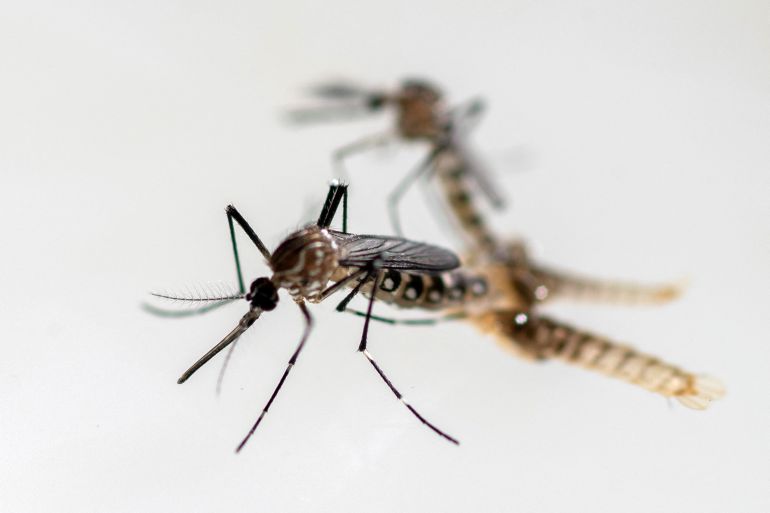
How Brazil’s mosquitoes are helping to fight dengue
Scientists are increasingly using novel ways to re-engineer mosquitoes and use them to battle the diseases they spread.


24 Nov 2026
Scientists in Brazil have successfully tested a novel way of battling dengue – by infecting mosquitoes with harmless bacteria instead of killing them or avoiding their sting.
Researchers presented encouraging results on Saturday at an international conference from a major study that tested thousands of children in Brazil, one of the world’s dengue hotspots.
end of list
The testing was done after the research team released millions of mosquitoes that had been re-engineered to carry a naturally occurring bacterium called Wolbachia, which makes it harder for viruses like dengue to grow inside them. The tests indicated dengue infections fell by 68.5 percent.
This is the latest effort to re-engineer mosquitoes to fight the diseases they spread to humans. The research findings were released as the US state of Florida grapples with an outbreak of dengue, thought to be one of the biggest in the United States since the 1940s.
“This is really exciting,” David Hamer, a global health expert at Boston University who wasn’t involved in the Brazilian study, told The Associated Press news agency.
Hamer predicted that using more Wolbachia mosquitoes could “knock dengue down to much lower levels” in many places.
Here’s what we know:

What did the study do?
An international team of investigators from Brazil’s Ministry of Health, Emory and Yale universities in the US, and the US National Institute of Allergy and Infectious Diseases conducted the study in Belo Horizonte in southeastern Brazil from 2020 to 2024.
The scientists infected Aedes aegypti mosquitoes with Wolbachia, a naturally occurring bacterium that does not harm humans but can significantly reduce mosquitoes’ ability to transmit some viruses. While the bacterium is present in about 50 percent of insects, the Aedes aegypti – responsible for transmitting dengue, chikungunya, Zika and yellow fever – does not carry it.
Researchers then released the mosquitoes and subsequently tested 5,700 children at random for dengue symptoms, including those living in areas where the infected mosquitoes had been released and those where standard measures like insecticides were used. Researchers also tested for a range of other diseases transmitted by mosquitoes, ticks and sandflies to catch asymptomatic patients.
Only 4 percent of the routine blood tests came back positive in areas where the Wolbachia-engineered mosquitoes were released, compared with 14 percent in other neighbourhoods. Dengue cases fell by 68.5 percent while chikungunya cases were reduced by 73.3 percent, the study found.
The number of dengue infections in Brazil is among the highest in the world, representing about one-tenth of all cases globally. Belo Horizonte, a densely populated city, was in the grips of its worst outbreak during the research period, further showing the efficacy of the Wolbachia method.
The results were presented at a meeting of the American Society of Tropical Medicine and Hygiene in the US state of Maryland.
Is this the first use of Wolbachia?
No. The World Mosquito Program (WMP) pioneered the Wolbachia method for its ongoing Wolbachia Mosquito Release Project.
The intervention, which has been carried out since the mid-2000s, has focused on regions that include Colombia’s Aburra Valley and the Brazilian city of Niteroi, which have a combined population of about 4.5 million people. Dengue infections there declined by 92 percent in the approximately 1 million people studied, the organisation reported. Researchers emphasised that the method is highly self-sustaining and more environmentally friendly than fumigation, which can be expensive and toxic.
In Singapore, authorities have pursued a Wolbachia-related population suppression approach since 2016. This entails releasing male mosquitoes carrying the bacterium to mate with wild urban females, which then produce eggs that do not hatch.
The scientists’ main aim is to create local populations of Wolbachia-carrying mosquitoes in the study areas. In the WMP intervention, scientists worked with local community leaders to release adult mosquitoes or place their eggs in food takeaway boxes, hoping they would transform into adults and mix with the local mosquito population. Over time, researchers believe, the Wolbachia population will reproduce and become established.
Where else have mosquitoes been used to fight disease?
Mosquitoes, specifically the female Anopheles, also transmit malaria, which is endemic in African countries. Children and pregnant women are most vulnerable to the disease, which can be deadly.
In 2024, researchers from Leiden University Medical Center and Radboud University in the Netherlands engineered mosquitoes to deliver vaccines that could provide immunity against malaria.
They did that by infecting mosquitoes with a modified strain of the malaria parasite, Plasmodium falciparum, which causes the deadliest strain in humans.
The parasite infects humans through mosquito bites. The insect uses its long, needle-like mouth to pierce the skin and inject its saliva into a person’s bloodstream before sucking blood out. Parasites in the saliva, which keeps blood from clotting and dulls pain, then travel directly to the liver, where they rapidly reproduce and infect red blood cells with malaria.
In the trials, researchers mirrored malaria transmission to strengthen liver immunity. However, while 80 percent of one group of participants developed immunity, the trial size was deemed too small to be generalised at just 20 people. It was not clear if the method would be more sustainable than actual vaccines in the long term, the scientists involved said.
Similarly, researchers in the US used the same method in a small trial of 26 participants in 2022 and found that it was 50 percent effective.
Meanwhile, in Japan in 2010, scientists modified mosquitoes to carry a vaccine against leishmaniasis, a parasitic disease typically spread by sandflies. Rodents bitten by the “flying vaccinators” developed antibodies against the parasite.