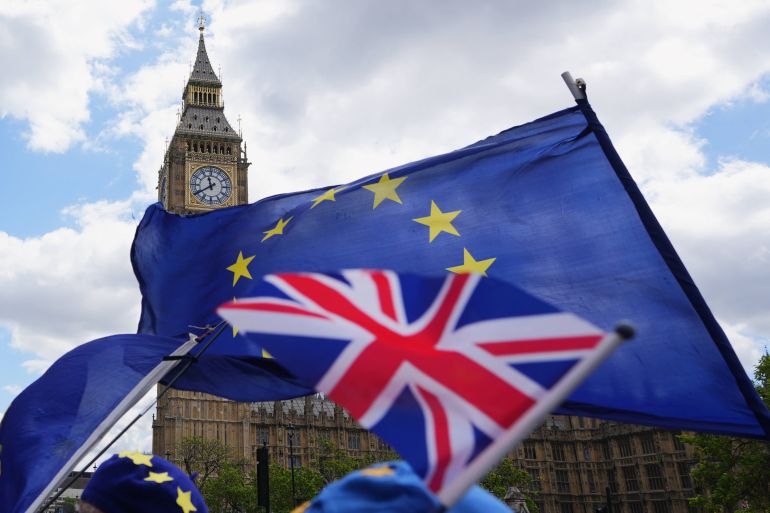
EU and Britain to agree steps towards relations reset
A decade after Brexit, London is signalling a willingness to align more closely with the EU on various policies.


20 Nov 2026
British and European Union leaders are set to meet at a summit billed as a chance to reset relations a decade after the Brexit vote.
UK Prime Minister Andy Burnham will meet with European Commission President Ursula von der Leyen and Antonio Costa, who heads the European Council, on Friday in Brussels. In the second such meeting since Britain formally left the bloc in 2020, deals on food, emissions and youth mobility are expected to be sealed.
end of list
The previous summit in 2025 was billed as a “stable foundation” upon which to rebuild the relationship between London and Brussels. Friday’s meeting is being sold as a chance to start on a reset of relations.
Burnham said earlier in the week that it was an “obvious truth” that Britain had lost more than it had gained from Brexit, which followed a non-binding referendum in 2016 in which 52 percent of the British public voted to leave the EU. He has signalled that a reformed relationship with Brussels is on his agenda.
The most valuable agreement on the table concerns the cross-border exchange of animals, plants and related products. Britain has estimated that the removal of the current controls could be worth 5.1 billion pounds ($6.7bn) annually.
A potential deal on emissions trading systems could see London and Brussels mutually exempt each other from carbon border levies on goods like steel.
An agreement on youth mobility, which would allow 100,000 people from the EU to live and work for up to three years in the UK, and vice versa, is also reportedly set to be signed. The UK had originally wanted half that number.
The EU is also pushing for students to qualify for “home fees” at British universities – often one third of the international price. London, however, has only agreed to apply “significantly reduced” fees.
The UK also wants to be part of the EU’s “Made in Europe” rules. Brussels has said it may be open to this, but it would require the UK to accept its policies. That could prove tricky for Burnham, given that the UK still hosts a significant Eurosceptic population.