More than 50,000 displaced by deadly Ethiopia border clashes
Families arrive in Kenya with little food or shelter as host communities struggle to cope.

9 Nov 2026
Moyale, Kenya – When Hawa Hassan fled her home in Ethiopia’s Moyale area, she left almost everything behind. Her house was burned during the violence, she said. But one memory has stayed with her: a 13-year-old girl shot while sitting near a wall.
Hassan said the girl had not touched a flag, a detail she raised while describing tensions over flag displays in the disputed border area. Her account of the killing could not be independently verified.
The journey into Kenya was brutal. Hassan told Al Jazeera that some women gave birth while fleeing, and that families arrived without food, cooking utensils or bedding. Newborn babies were sleeping on bare floors. Diarrhoea was spreading, while families feared malaria as mosquitoes multiplied.
For many, crossing the border has meant escaping gunfire only to face another struggle: finding food and shelter. The arrivals are also stretching Kenyan communities. Families that opened their homes are sharing scarce supplies, even as some worry the violence could reach their own neighbourhoods.
A crisis growing by the day
A government-led assessment conducted on October 29 and 30 estimated that 35,950 people had been displaced as of October 24. About 25,000 were staying with host families and nearly 11,000 in temporary displacement sites.
The number has since risen. During a meeting, Kenya Red Cross regional head Malik Adan said the number of people displaced by the conflict had increased from an estimated 36,000 to more than 50,000. The figure includes people living in temporary settlements as well as those staying with relatives and host families.

The overall number of displaced people has yet to be independently established, and no final figure has been confirmed.
The assessment covered 758 households and involved government authorities, United Nations agencies, the Kenya Red Cross and other humanitarian organisations. The figures reflect different reporting periods.
The fighting is rooted in a long-standing dispute over land and administrative control between Ethiopia’s Oromia and Somali regional administrations. Tensions escalated around October 18 over the raising of the Somali regional flag in the disputed Moyale area, reflecting competing claims over territory and authority.
For those arriving in Kenya, the politics are secondary to the immediate question of where they will sleep and what they will feed their children.
Aid stretched on both sides
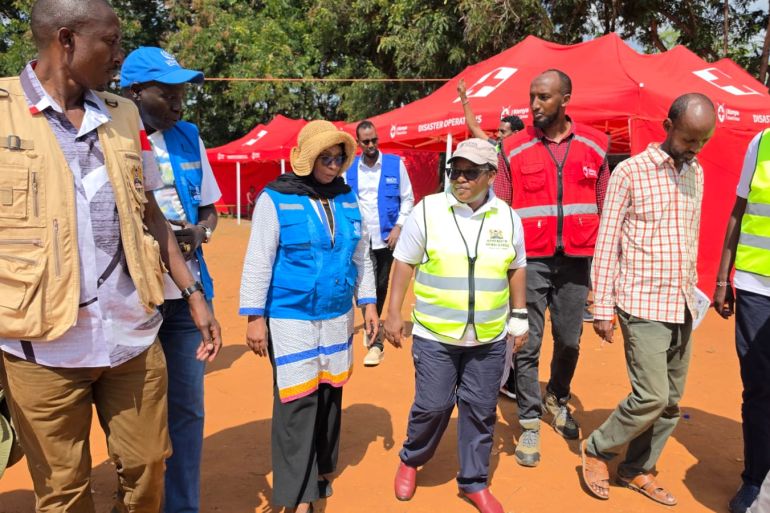
Mwasaru Mercy, Kenya’s acting commissioner for refugee affairs, told Al Jazeera that a multi-agency government team had been deployed to Moyale. The Department of Refugee Services is coordinating with local authorities and the UN High Commissioner for Refugees (UNHCR).
But gunfire could still be heard, Mercy said, raising fears of further displacement. Many arrivals need food, shelter, bedding and mosquito nets.
“There are no contingency food stocks specifically for this incident because it happened abruptly,” Mercy said.
Authorities are trying to mobilise humanitarian organisations and donors. A refugee camp has not been established because the security situation must improve first. The government is working with UNHCR to register arrivals and assess their needs.
Those affected include Ethiopians fleeing violence, traders, and Kenyans forced from their homes by stray ammunition, Mercy said.

Fatima Mohammed Cole, UNHCR’s representative in Kenya, said many arrivals were women and children. Families are spread across several locations, including six sites hosting Ethiopians. They need shelter, food and healthcare, while crowded conditions raise concerns about the spread of disease.
Cole said gunfire was still being heard in Moyale and appealed for a ceasefire that would allow families to return home.
The response is also under way inside Ethiopia. The Ethiopian Red Cross Society said it had provided emergency shelter and household items worth about 30 million Ethiopian birr ($182,970) to 1,000 households displaced from Moyale town and surrounding areas.
The supplies included 2,000 tarpaulins, blankets and sleeping mats, as well as dignity kits, jerrycans, kitchen sets, soap and solar lamps. Distribution was under way, the organisation said. The operation is separate from assistance in Kenya.
Host communities under pressure
In Kenya, residents who initially opened their doors are finding it harder to keep going.
Abdi Maalim, a member of the Moyale Cross-Border Peace Committee, told Al Jazeera that some Kenyan families had moved further inland after bullets and heavy weapons landed close to their homes. He called for more border patrols to prevent armed groups from crossing into Kenya.
Families that once cooked for five or six people are now feeding 20 or 30.
Moyale’s role as a trading point between Kenya and Ethiopia has added to the strain. Maalim said trucks carrying goods between Mombasa and Addis Ababa had been stranded near the border for almost two weeks. Kenyan trucks were also stuck in Ethiopia, and businesses in Moyale had slowed sharply.
Bank closures have disrupted the circulation of the Ethiopian birr. Traders reported price rises of about 20 percent as supplies became harder to move.
Fears of wider instability
Security analyst Dr Abdiwahab Sheikh Abdisamad told Al Jazeera that the clashes had grown beyond a local dispute over territory, exposing deeper ethnic divisions and political competition between Ethiopia’s regional administrations.
He said perceptions of Oromo expansionism and allegations of federal government support for Oromia’s regional leadership risked deepening mistrust. He warned that armed fighters crossing the border, stray bullets and further displacement made this a Kenyan security concern as well as a refugee emergency.

Kenya’s Inspector General of Police, Douglas Kanja, said additional officers would be deployed along the border to strengthen security. During a visit to Moyale on November 5, he said Kenya was engaging Ethiopia’s federal government to help end the conflict.
Kanja said about 10,000 people were staying in temporary shelters and public institutions, while others had been taken in by host families. He said one Kenyan had died after being hit by a stray bullet, while a police report indicated that an Ethiopian man had also died from gunshot wounds sustained in Kenya.
The 10,000 figure refers to people in temporary shelters and public institutions, not the total number displaced. It is not directly comparable with the Red Cross estimate of more than 50,000, which includes people staying with host families.
Hassan wants to return home, but only when it is safe. Until then, she and thousands of others depend on host communities and humanitarian agencies. The longer the fighting continues, the harder it will be for those communities to keep absorbing the cost.
Maalim said residents had already stretched their resources to accommodate the new arrivals.
“Previously, we were supplying this town alone. Now we are literally taking care of two towns together,” he told Al Jazeera.