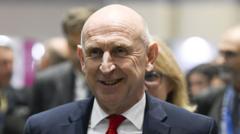
The Chancellor, John Healey, is planning to increase taxes on bank profits, senior banking executives have told the BBC.
Healey has described banks as part of “the crown jewels” of the UK economy, but leaders in the sector have said it will be “on the menu” at the Budget in two weeks’ time.
The biggest four banks collectively made about £15bn profit in the first six months of this year, and trade unions have called for them to face additional taxes.
The trade body for the banking sector, UK Finance, warned “further increases in bank taxes would weaken competitiveness, discourage investment and job creation, and work against the government’s ambition to deliver growth in every postcode”.
The UK’s biggest banks and building societies currently pay a surcharge of 3% on top of the baseline 25% rate of corporation tax, plus a levy on the assets held on their balance sheets.
The sector contributed nearly £40bn to the Treasury last year, if income tax on employees is factored in.
The bank levy generated £1.4bn last year and the surcharge a further £1.2bn.
There are a number of ways the chancellor could extract more money from the sector.
The 3% surcharge was reduced from 8% under Rishi Sunak, at the same time as he raised corporation tax from 19% to 25%. Returning the surcharge to its previous level could raise around £2bn a year.
The bank levy currently charges 0.1% on outstanding short-term loans and 0.05% on longer-dated loans, although mortgages are excluded from the calculation.
In the past banks have successfully argued that higher taxes would risk making the UK uncompetitive with other jurisdictions and would reduce their ability to lend, and therefore be anti-growth.
Sir Philip Augar, an author and former banker in the City of London, told the BBC’s Today programme there was “room for a moderate increase” in taxes on the sector that could raise up to £3bn a year.
He said lenders were enjoying “booming conditions”, benefiting from higher interest rates which boost their profits.
Rising interest rates have expanded the margin between the rate at which banks lend to customers and the rate they pay savers.
Sir Philip added that when the banking sector “hits really rocky times it expects the taxpayer to bail them out – when it hits boom times, it expects some kind of special treatment”.
He said banks cannot simultaneously be “too big to fail and too big to tax”.
Paul Nowak, general secretary of the Trades Union Congress, which represents trade unions, said the majority of bank workers “are not fat cats or city high rollers”, adding that “we want a successful financial services industry in the UK”.
“But if the chancellor does ask the Banks to pay a fairer share of tax in the Budget, that’s 100% the right call,” he added.