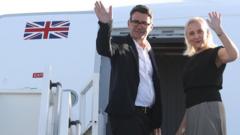
Asked about the state of the relationship between the UK and US, the prime minister said he believes it is “as strong as it’s ever been”.
Burnham has travelled to New York with his wife, Marie-France Van Heel, for a day of diplomacy and a speech to the UN General Assembly, which is expected to focus on the opportunities and dangers associated with artificial intelligence (AI).
He said: “I will be making the case for closer international cooperation on AI, a just and lasting peace in Ukraine, and renewed efforts to bring an end to the conflict in the Middle East because what happens abroad impacts each and every one of us at home.”
The prime minister will also announce the start of work on a new AI and Autonomy partnership between the UK and the US, focused on protecting critical national infrastructure using AI tech.
Lib Dem leader Sir Ed Davey is expected to criticise this plan at the final day of his party’s conference, saying it “doesn’t come close to meeting the scale of the threat” and “only risks making us more dependent on a Trump administration in the pocket of the tech bros”.
He will also call for a global pause on superintelligent AI and propose a new International AI Safety Agency.
His criticisms come after a series of stark warnings from the AI industry about the technology’s possible dangers.
For a new British prime minister, the first meeting with a US president has always been a pivotal encounter, but officials are well aware of the added jeopardy of a public appearance alongside the most unpredictable president in American history.
In advance of the meeting, the UK revealed that the UK and the US have, for the first time, fired an American torpedo from a British undersea drone in a military exercise.
The torpedo, described as “heavyweight” by UK officials, is “designed to sink ships and deep diving submarines”, Downing Street said.
It was launched in UK waters last week from a 12-metre long undersea drone called Excalibur, made in Plymouth.
It is the first time either the UK or the US have launched a torpedo from an uncrewed underwater vessel, rather than a crewed submarine, and is seen as a breakthrough in attempts to protect vital infrastructure such as deep sea data cables.
“Our work together already shows what can be achieved when our two countries combine our expertise and innovation,” the prime minister said.
Burnham was also asked by reporters about the UK government seeking to hand over the Chagos Islands to Mauritius and pay to lease back the joint US-UK military base on Diego Garcia.
It was confirmed in April that the deal had been paused indefinitely because of Trump pulling his support.
Burnham spoke to the Mauritian prime minister, Navin Ramgoolam, on Monday.
He was asked by reporters to outline what he had told Ramgoolam, whether he supported the deal and if he had a plan to convince Trump to back it.
Burnham replied: “I said that we remain determined to secure the long-term operation of the base, which is crucial to our security and that of our allies.
“The assurance I gave was I will work towards a resolution, at the moment we don’t have that, but I gave an assurance that I would commit to working towards one.”